NMRDfromMD
NMRDfromMD is a Python toolkit for computing nuclear magnetic resonance (NMR) relaxation properties directly from molecular dynamics (MD) trajectories (Figure 1). From atomistic simulations, it evaluates the dipolar interactions between nuclear spins to calculate the longitudinal (\(T_1\)) and transverse (\(T_2\)) relaxation times. NMR relaxation is sensitive to molecular motion over a broad range of timescales, making it a powerful probe of translational and rotational dynamics in liquids, confined fluids, polymers, and biological systems. By extracting relaxation times from MD simulations, NMRDfromMD enables direct comparison with experimental NMR measurements, allowing users to validate simulation models and identify the molecular mechanisms underlying relaxation. It can also be used to predict and interpret NMR relaxation behavior when experimental data are unavailable.
Compatible Simulation Packages
NMRDfromMD accepts any trajectory format supported by MDAnalysis, covering virtually all major MD simulation packages including LAMMPS, GROMACS, NAMD, AMBER, CHARMM, and many others. For a full list of supported formats, see the MDAnalysis documentation.
This package builds on the now discontinued NMRforMD.
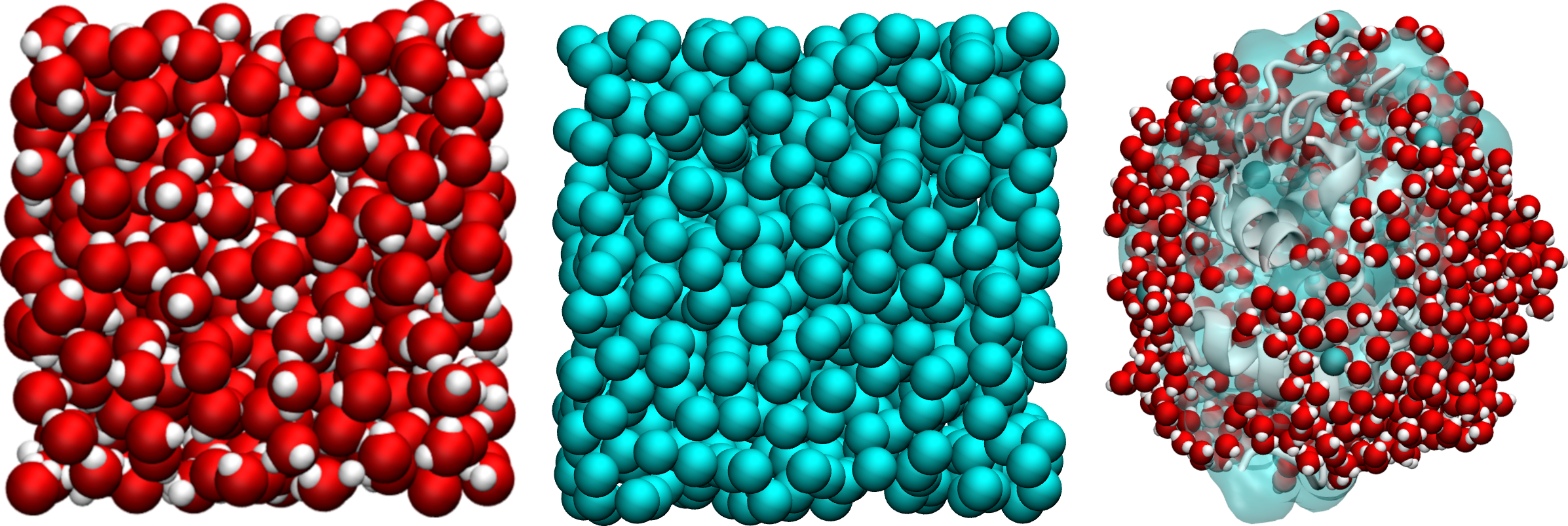
Figure 1: Examples of systems that can be analyzed with NMRDfromMD, spanning simple bulk liquids (water, left), idealized Lennard-Jones fluids (center), and biologically relevant systems such as a lysozyme protein and its hydration shell (right).
Installation
To install the latest development version of NMRDfromMD, clone the repository,
NMRDfromMD, from GitHub, and use pip from the main directory:
git clone https://github.com/NMRDfromMD/nmrdfrommd.git

cd nmrdfrommd/

pip install .
To run the test suite, install the testing dependencies:
pip install pytest coverage
Then run from the tests folder:
pytest
Datasets
Molecular dynamics datasets are available on GitHub: a polymer in water system generated using LAMMPS, and a water confined in silica system generated using GROMACS. These datasets can be downloaded to follow the tutorials or simply to test NMRDfromMD.