Isotropic consistency of \(G^{(m)}\)
Here, we verify one of the central assumptions used when measuring NMR relaxation properties of isotropic bulk liquids, for which no direction in space is preferred. For such isotropic systems, the three second-rank dipolar correlation functions are expected to satisfy [23]
The three correlation functions \(G^{(m)}\) differ only by their spherical harmonic order \(m = 0, 1, 2\). Because all orientations are equally probable, the orientation average cannot depend on \(m\), and the functions \(G^{(m)}\) are therefore proportional to one another. A similar benchmark was done, for instance, in Ref. [14] with glycerol.
The numerical prefactors \(1, 6, 6/4\) arise solely from the explicit forms of the rank-2 spherical harmonics \(Y_2^m\), whose squared moduli satisfy \(|Y_2^0|^2 : |Y_2^1|^2 : |Y_2^2|^2 = 1 : 3 : 3\), combined with the symmetry factor accounting for \(m > 0\) pairs.
Our results obtained from a bulk water system show that the proportionality relation is well verified. Small deviations become visible at times longer than approximately 20 ps in the intermolecular correlation functions and are likely due to statistical fluctuations.
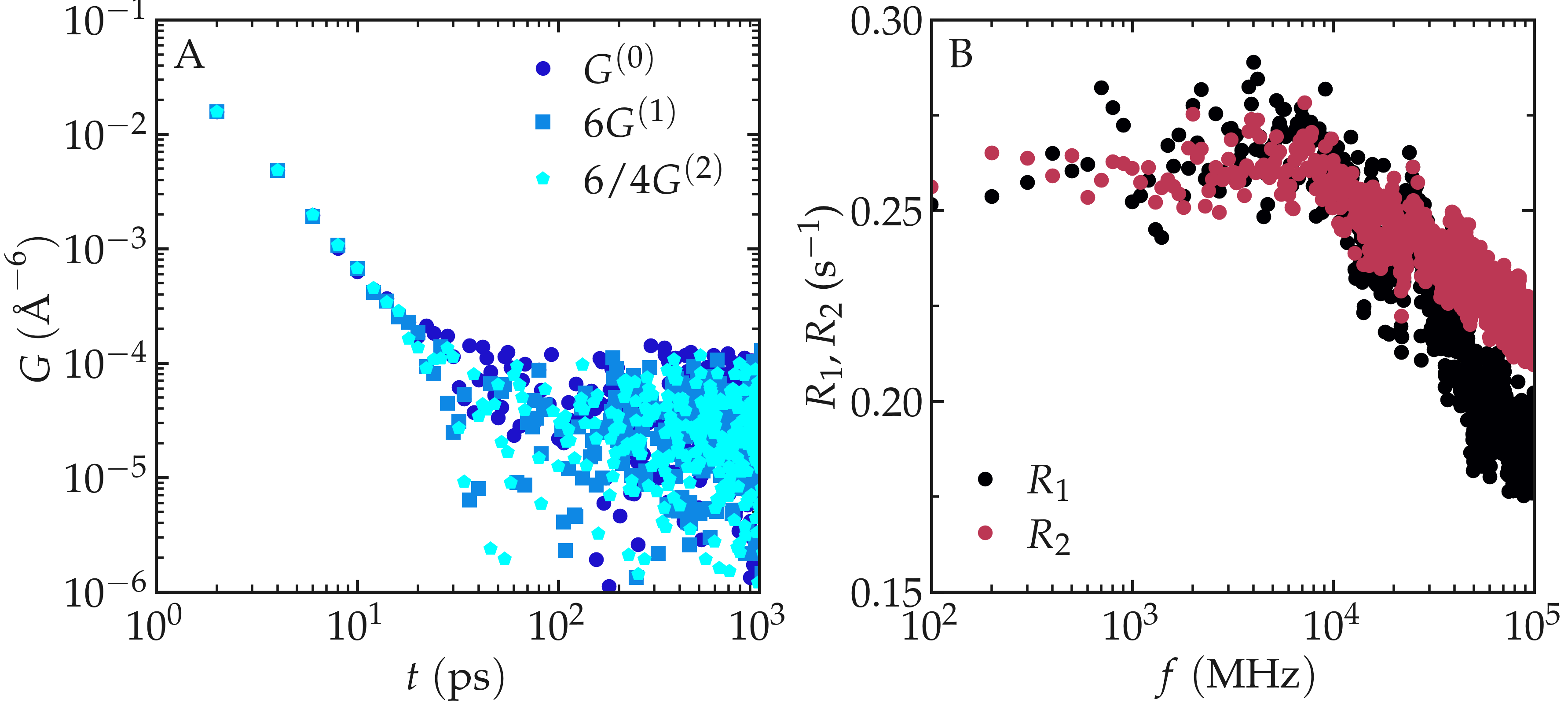
Figure: A) Comparison between \(G^{(0)}\), \(6 G^{(1)}\) and \(\frac{6}{4} G^{(2)}\) obtained from a bulk water molecular dynamics simulation. B) Comparison between the intermolecular correlation functions \(G_\mathrm{T}^{(0)}\), \(6 G_\mathrm{T}^{(1)}\) and \(\frac{6}{4} G_\mathrm{T}^{(2)}\).