Nanoconfined water
Here, the \(^1\text{H}\) NMR relaxation rate \(R_1\) of water confined within a silica nanoslit is calculated from molecular dynamics simulations. The temperature is \(T = 300~\mathrm{K}\), and the water model is \(\text{TIP4P}-\epsilon\). Simulation details are provided in Simulation methods. For such an anisotropic system, all three correlation functions, \(G^{(1)}\), \(G^{(2)}\), and \(G^{(3)}\), must be evaluated. Hydrogen atoms belonging to both the water molecules and the hydroxyl groups on the silica surface contribute to the relaxation, particularly because water forms hydrogen bonds with the surface.
Using NMRDfromMD, we calculated both the total relaxation rate and the contribution arising from water-surface interactions. Our results indicate that the contribution from water-silica interactions is approximately one order of magnitude smaller than the total relaxation rate, indicating that most of the relaxation originates from the water itself through its rotational motion and intermolecular interactions (Fig. 1). This is mainly due to the relatively small number of hydrogen atoms on the silica surface (92), compared with the 1204 hydrogen atoms belonging to the water molecules.
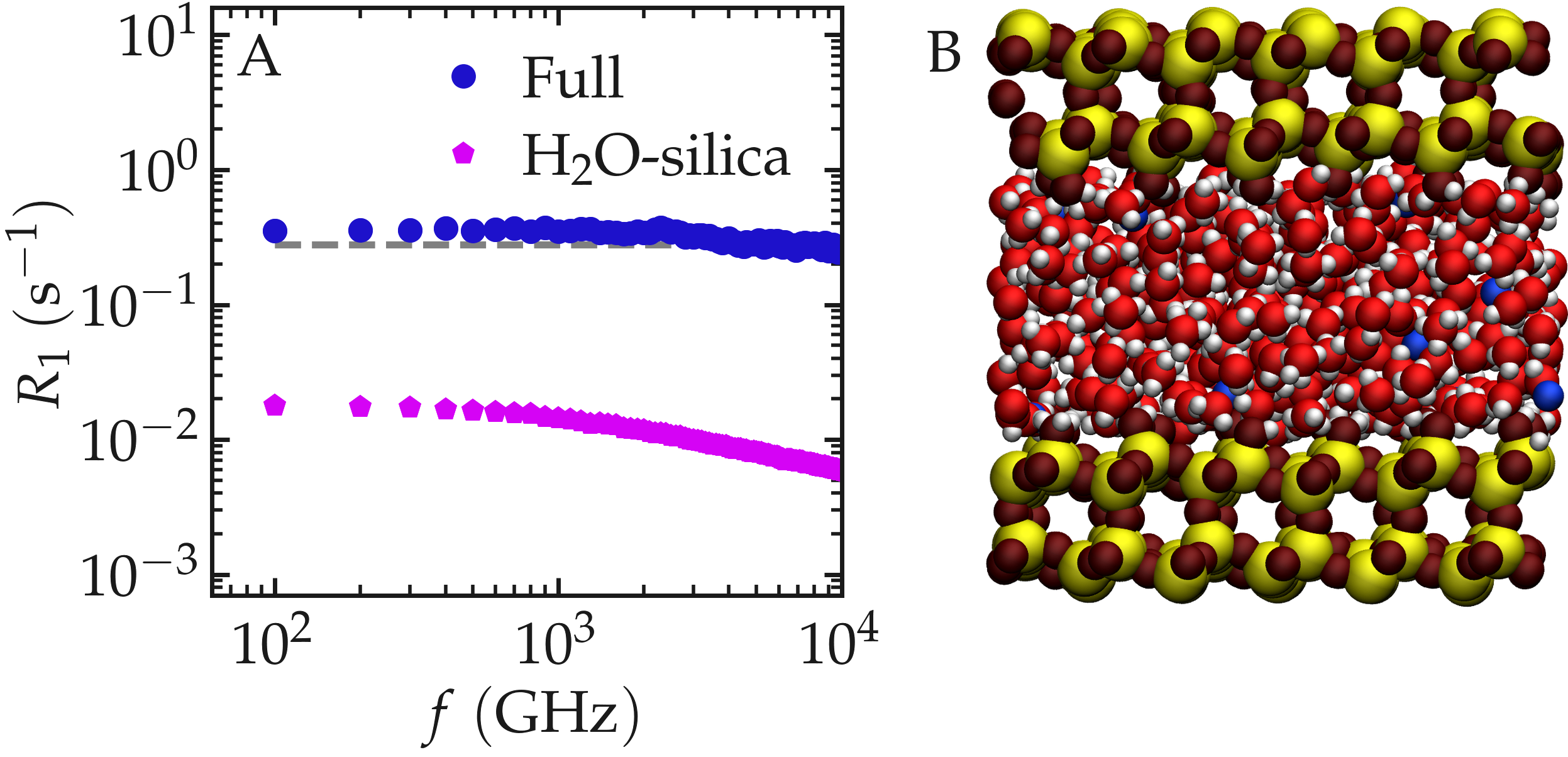
Figure 1. (A) \(^1\text{H}\) NMR relaxation rate \(R_1\) of water confined within a silica slit. The contribution arising from water-silica interactions is shown by the pink pentagons. The dashed line marks the expected relaxation rate of \(0.28~\mathrm{s}^{-1}\) for the same TIP4P water model at the same temperature, \(T = 300~\mathrm{K}\). (B) Snapshot of the molecular dynamics system, with water molecules shown in red and white, silicon atoms in yellow, and sodium counterions in blue.
Although the direct contribution of water-surface interactions to NMR relaxation is small, confinement still significantly affects the relaxation rate by modifying the structure and dynamics of the confined water. In particular, confinement generally slows the molecular dynamics of water, resulting in altered relaxation rates. Furthermore, the confined water can be viewed as consisting of two populations: a slow, highly structured interfacial population located near the silica surface, and a bulk-like population farther from the surface whose properties are only weakly affected by confinement [44]. As a consequence, the total relaxation rate is slightly larger than that measured for bulk water under the same conditions (Fig. 1).