Tutorial
In this tutorial, the proton (\(^1\mathrm{H}\)) NMR relaxation properties of a polymer-water mixture is computed from a molecular dynamics trajectory. More specifically, NMRDfromMD is used to extract the frequency-dependent relaxation rates [\(R_1(f)\) and \(R_2(f)\)], separate the intra- and intermolecular contributions to the relaxation, and diferentiate the relative contribution from water and from the polymer to the relaxation.
To follow the tutorial, MDAnalysis, NumPy, and Matplotlib must be installed alongside NMRDfromMD.
File preparation
The system consists of a bulk mixture containing 420 water
molecules and 30 polyethylene glycol (PEG 300) chains, simulated at \(T=300~\mathrm{K}\)
and \(p=1~\mathrm{atm}\) using LAMMPS. Details are given in Simulation methods.
To access the LAMMPS input files and pre-computed trajectory data, clone the
peg-water-mixture dataset repository. The required trajectory files are
located in the data/ directory.
Important
The trajectory files are stored using Git Large File Storage (Git LFS). This means that after cloning the repository, you must download the actual trajectory data before using it.
If Git LFS is not installed, install it first:
apt install git-lfs
git lfs install
Then retrieve the trajectory files:
git lfs pull
Alternatively, you can regenerate the trajectory by rerunning the LAMMPS simulation scripts provided in the repository.
Import the simulation data into Python
Open a new Python script or Notebook, and define the path to the data files:
datapath = "mypath/dataset-peg-water-mixture/data/"
Then, import NumPy, MDAnalysis, and the NMRD module of NMRDfromMD:
import numpy as np
import MDAnalysis as mda
from nmrdfrommd import NMRD
From the trajectory files, create a MDAnalysis Universe by loading the configuration file and trajectory:
u = mda.Universe(
    datapath+"production.data",
    datapath+"production.xtc"
)
The Universe is a central object in MDAnalysis. It combines the system topology (atom identities, masses, molecule definitions, etc.) with the time-dependent atomic coordinates. NMRDfromMD uses this Universe to access both the molecular structure and the atomic trajectories required to compute dipolar correlation functions and NMR relaxation properties.
Before starting the analysis, it is useful to verify that the system has been correctly loaded and to inspect its basic composition:
H2O = u.select_atoms("type 6 7")
PEG = u.select_atoms("type 1 2 3 4 5")

n_TOT = len(u.residues)
n_H2O = len(H2O.residues)
n_PEG = len(PEG.residues)

print(
    f"System: {n_TOT} molecules"
    f"({n_H2O} H2O, {n_PEG} PEG)"
)
Executing the script using Python will return:
System: 450 molecules (420 H2O, 30 PEG)
This output confirms that the simulation contains the expected 450 molecules, correctly partitioned into 420 water molecules and 30 PEG chains. This corresponds to an ethylene oxide (EO) over water ratio of 0.46.
Let us also print information about the trajectory: frame_dt
and the total duration of the simulation, total_time:
frame_dt = np.int32(u.trajectory.dt)
total_time = np.int32(u.trajectory.totaltime)

print(f"Trajectory: {frame_dt} ps/frame, "
    f"{total_time//1000} ns total")
Executing the script using Python will return:
Trajectory: 2 ps/frame, 10 ns total
The frame_dt refers to the time interval between two
stored frames in the trajectory file, not the integration timestep used
in the molecular dynamics simulation. In this tutorial, the trajectory was generated with LAMMPS using a
1 fs integration timestep, but atomic configurations were written to the
production.xtc file every 2 ps. As a result, frame_dt corresponds to
the 2 ps sampling interval, which determines the
temporal resolution of all subsequent correlation functions and relaxation calculations.
Run the \(^1\text{H}\) NMR relaxation analysis
First, three atom groups are created: one group containing the hydrogen atoms belonging to PEG, another group containing hydrogen atoms belonging to water, and the combined set containing all hydrogen atoms:
H_H2O = H2O.select_atoms("type 7")
H_PEG = PEG.select_atoms("type 3 5")
H_ALL = H_PEG + H_H2O
To extract the NMR relaxation properties from the entire system, NMRDfromMD is first executed on all hydrogen atoms:
nmr_all = NMRD(
    u=u,
    atom_group=H_ALL,
    number_i=20
)
res_nmr = nmr_all.run_analysis()
On a standard laptop (Intel Core i9-12900H processor), this step
typically takes 1-2 minutes. The runtime depends mainly on three factors:
(i) the number of selected reference atoms (number_i),
(ii) the number of atoms in the system,
and (iii) the number of saved trajectory frames.
The parameter number_i controls how many reference hydrogen atoms are
randomly selected for the calculation. Computing the dipolar interaction
for every hydrogen atom can become computationally expensive in large
systems. Instead, NMRDfromMD samples a subset of reference atoms
while retaining all neighbouring atoms. This sampling reduces the computational
cost at the expense of increased statistical uncertainty.
All calculated values are stored within the res_nmr dictionary.
Let us first extract the NMR relaxation time \(T_1\) in
the limit \(f \to 0\), add the following lines to the Python script:
T10 = res_nmr["T1"][0]
T10_err = res_nmr["T1_err"][0]

print(f"The NMR relaxation time is T1 = {T10:.2f} pm {T10_err:.2f} s")
The expected output is
The NMR relaxation time is T1 = 0.64 pm 0.47 s
The error on \(T_1\) is relatively large due to the small
value of number_i used. Increasing
number_i reduces this statistical uncertainty. Avalue of 200
for number_i returns:
The NMR relaxation time is T1 = 0.64 pm 0.47 s
For reference, experimental measurements by Jora report the value for \(T_1\) for a water PEG 300 mixute with a similar ethylene oxide (EO) over water ratio equal to \(T_1 = 0.7\) s [24].
Alongside the relaxation time, \(T_1\), the longitudinal and transverse relaxation rates,
are available for every frequency \(f\) (in MHz) as res_nmr["R1"]
and res_nmr["R2"]. The corresponding frequencies are stored in
res_nmr["f"].
R1_spectrum = res_nmr["R1"]
R2_spectrum = res_nmr["R2"]
f = res_nmr["f"]
The spectra \(R_1 (f)\) and \(R_2 (f)\) can then be plotted as a function of \(f\) using pyplot:
from matplotlib import pyplot as plt

# Plot settings
plt.figure(figsize=(8, 5))
plt.loglog(
    f,
    R1_spectrum,
    "o",
    label="R1",
    markersize=5,
)
plt.loglog(
    f,
    R2_spectrum,
    's',
    label='R2',
    markersize=5
)
# Labels and Title
plt.xlabel(
    "Frequency (MHz)",
    fontsize=12
)
plt.ylabel(
    "Relaxation Rates (s-1)",
    fontsize=12
)
# Grid and boundaries
plt.grid(
    True,
    which="both",
    linestyle='--',
    linewidth=0.7
)
plt.xlim(80, 1e5)
plt.ylim(0.05, 2)
# Legend
plt.legend()
plt.tight_layout()
plt.show()
The resulting spectra should resemble Figure 1, panel A. For an isotropic liquid, \(R_1(f)\) and \(R_2(f)\) are expected to approach similar values in the low-frequency limit. In this regime, both relaxation rates probe the low-frequency limit of the spectral density, which is dominated by long-time molecular reorientations and translational diffusion.
Because only number_i = 20 reference atoms are sampled here, the
spectra exhibit noticeable statistical noise. Repeating the calculation
with a larger value for number_i produces much smoother curves, as
shown Figure 1, panel B.
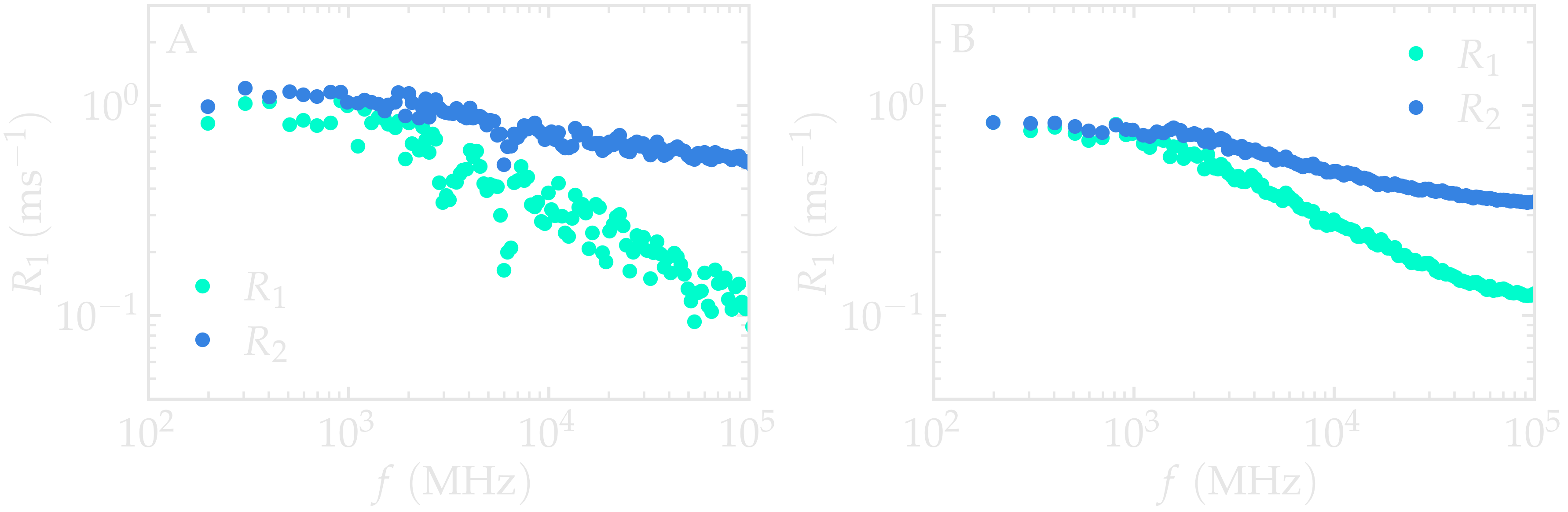
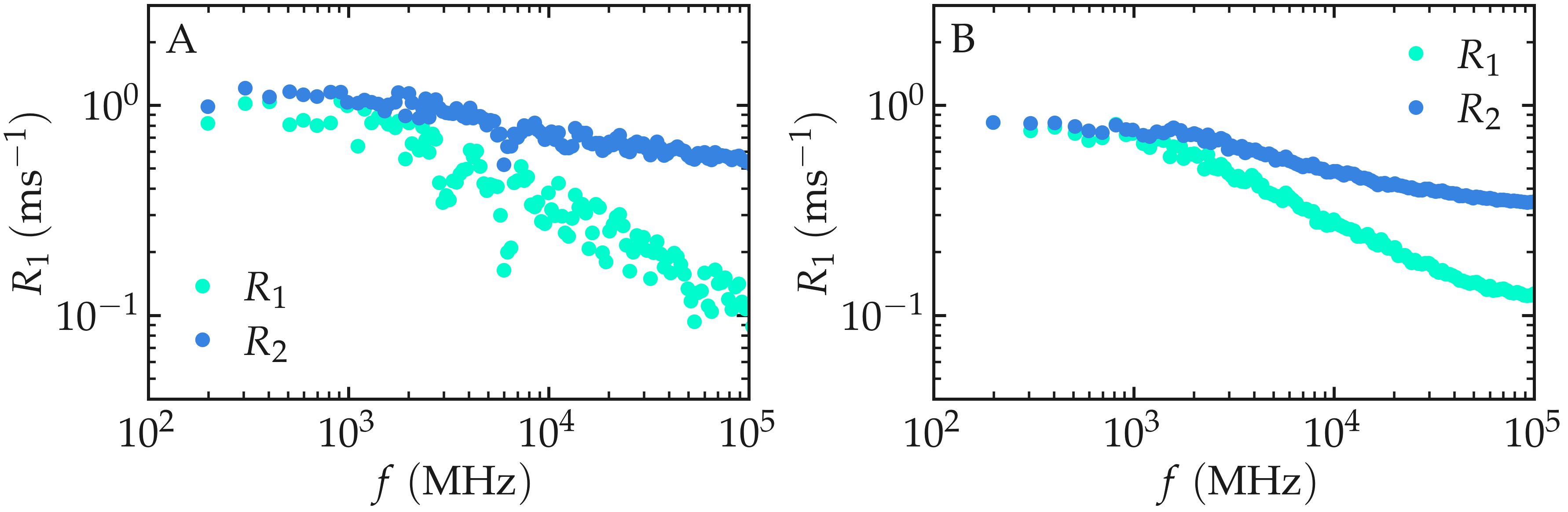
Figure 1: (A) \(^1\text{H}\)-NMR relaxation
rates \(R_1\) and \(R_2\) as a
function of the frequency \(f\) for the
\(\text{PEG-H}_2\text{O}\) bulk mixture. Results are given for
a small value of number_i, \(n_i = 20\).
(B) Same quantity as in panel A, but performed using all hydrogen atoms
using \(n_i = 0\).
Separating intra and intermolecular
So far, the relaxation rates were calculated without distinguishing between intra- and intermolecular interactions. One of the major advantages of molecular dynamics simulations is that every dipolar interaction can be classified according to whether it originates from two nuclei within the same molecule or from two different molecules. This separation is generally not accessible from experimental measurements alone.
Let us extract the intramolecular contributions to the relaxation for both water and PEG, separately:
nmr_h2o_intra = NMRD(
    u=u,
    atom_group=H_H2O,
    type_analysis="intra_molecular",
    number_i=200)
res_h2o_intra = nmr_h2o_intra.run_analysis()

nmr_peg_intra = NMRD(
    u=u,
    atom_group=H_PEG,
    type_analysis="intra_molecular",
    number_i=200)
res_peg_intra = nmr_peg_intra.run_analysis()
Similarly, we can also measure the intermolecular contributions:
nmr_h2o_inter = NMRD(
    u=u,
    atom_group=H_H2O,
    type_analysis="inter_molecular",
    number_i=20)
res_h2o_inter = nmr_h2o_inter.run_analysis()

nmr_peg_inter = NMRD(
    u=u,
    atom_group=H_PEG,
    type_analysis="inter_molecular",
    number_i=20)
res_peg_inter = nmr_peg_inter.run_analysis()
The intermolecular contribution is
computed only between molecules belonging to the same chemical species.
For example, nmr_h2o_inter includes interactions between different
water molecules, but not between water and PEG molecules.
The water-PEG intermolecular contribution can be computed by selecting
water hydrogen atoms as the reference group (atom_group) and PEG
hydrogen atoms as the interacting partner group (neighbor_group):
nmr_h2o_peg = NMRD(
    u=u,
    atom_group=H_H2O,
    neighbor_group=H_PEG,
    number_i=20)
res_h2o_peg = nmr_h2o_peg.run_analysis()
In this case, the analysis is already restricted to intermolecular
interactions between two different molecular species. Therefore, it is
not necessary to explicitly set type_analysis="inter_molecular".
Comparing the calculated spectra reveals that the intramolecular contribution is larger than the intermolecular one for this system (Figure 2). More importantly, the two contributions exhibit distinct frequency dependences because they originate from different molecular motions. Intramolecular relaxation is mainly governed by rotational motion and internal molecular flexibility, whereas intermolecular relaxation reflects translational diffusion and inter-molecular collisions.
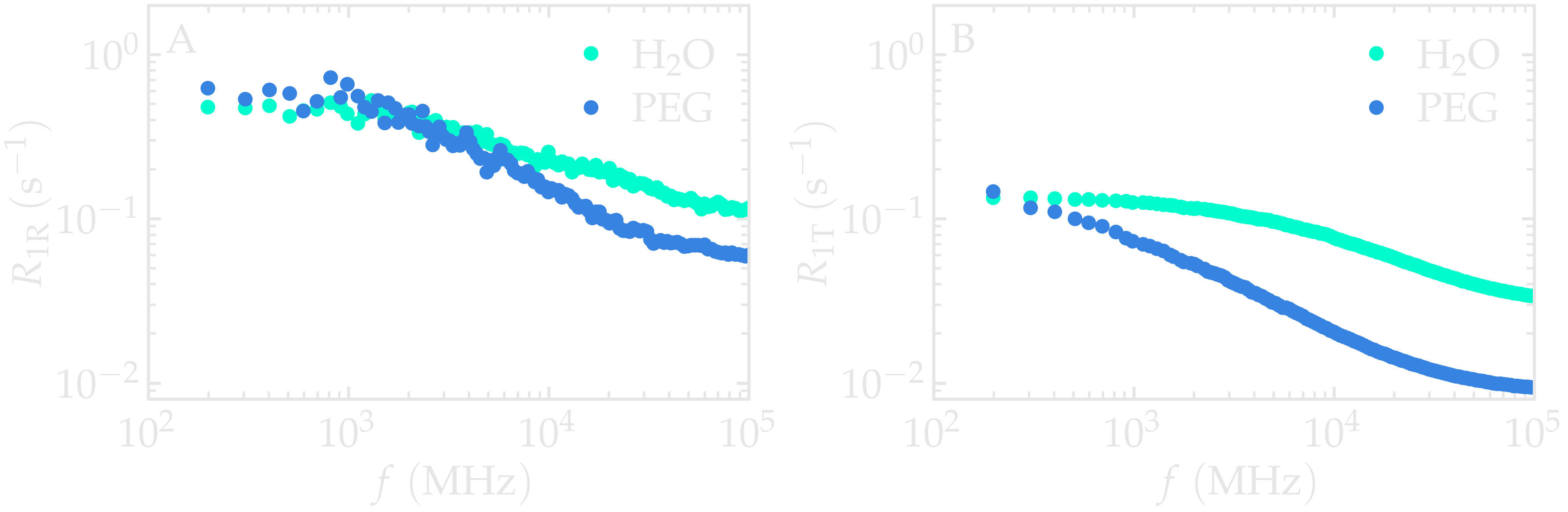
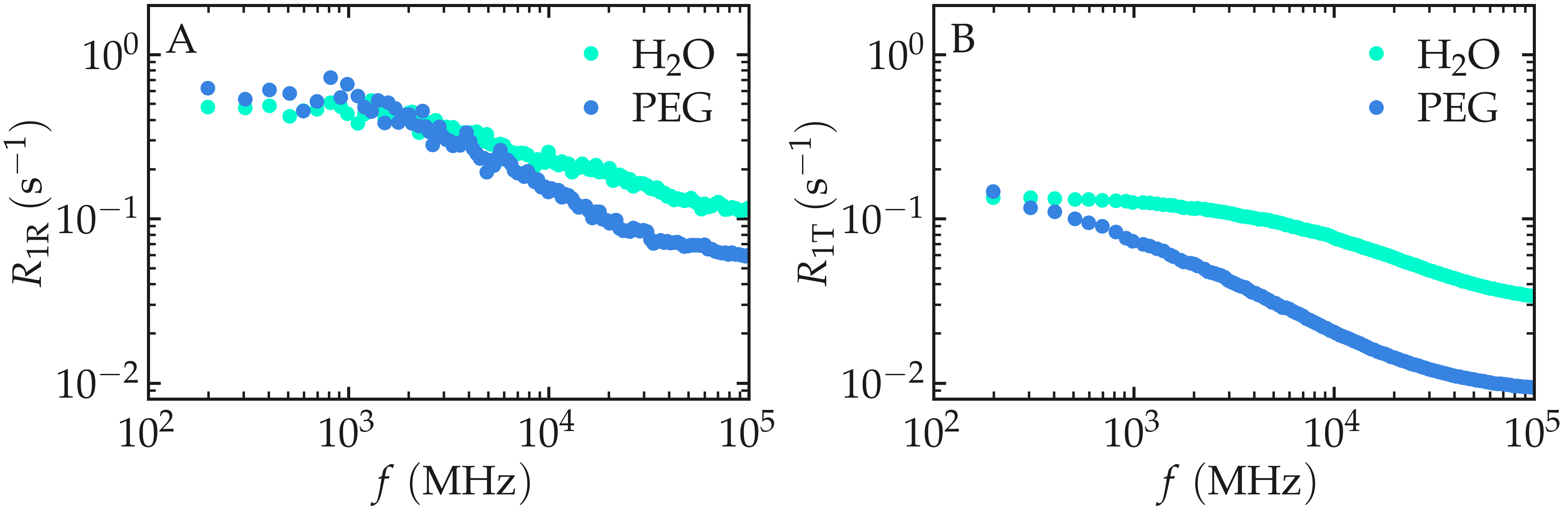
Figure 2: Intramolecular \(^1\text{H}\)-NMR relaxation rates \(R_{1 \text{R}}\) (A) and Intermolecular \(^1\text{H}\)-NMR relaxation rates \(R_{1 \text{T}}\) (B) as a function of the frequency \(f\) for PEG and \(\text{H}_2\text{O}\) separately. Results are shown for \(n_i = 0\).