Lorentzian and diffusion models
This section describes how molecular dynamics trajectories are used to identify the appropriate models for NMR relaxation. The dipolar fluctuations extracted from the trajectories are first converted into correlation functions and spectral densities. Their functional forms then reveal the underlying relaxation mechanisms: a Lorentzian model associated with rotational diffusion and a diffusion-based model associated with translational motion.
Although the behaviour of a single pair of nuclei is informative, NMR relaxation is a collective property. The relaxation rates are obtained by averaging the fluctuations of \(F_2^{(0)}\) over all relevant pairs of nuclei and over the complete molecular dynamics trajectory.
From the fluctuating quantities \(F_2^{(0)}\) summed over all available pairs of spins, one can extract the two correlation functions \(G_\textrm{intra}^{(0)}\) and \(G_\textrm{inter}^{(0)}\) (see Eqs. (3) and (4)).
For comparison, the results obtained at two different temperatures, 275 and 300 K, are reported.
At short times, \(t < 40\) ps, the intramolecular correlation functions follow an exponential decay,
where \(\tau_\text{intra} = 6.3\) ps was used for \(T = 300\) K and \(\tau_\text{intra} = 3.2\) ps was used for \(T = 275\) K, see the figure below.
An exponential decay, such as Eq. (9), is characteristic of processes governed by a single correlation time. Such behaviour is commonly used to describe isotropic rotational diffusion and provides a good approximation for the short-time intramolecular dynamics of liquid water [3].
The intermolecular correlation functions, however, display a different behaviour. They follow an exponential decay only at short times (a few tens of picoseconds). At longer times, translational diffusion continually brings new molecular neighbours into and out of the local environment. This leads to the characteristic power-law decay \(G_\text{inter}(t) \sim t^{-3/2}\), which is a hallmark of diffusive dynamics.
This scaling has been predicted theoretically for freely diffusing particles, and analytical expressions were derived by Ayant et al. [55] and Hwang and Freed [56] in the context of hard-sphere diffusion.
Following Ref. [2], we refer to this description as ADHF.
While the ADHF description captures the long-time decay of the correlation function, it does not lead to a Lorentzian spectral density. This reflects the fact that intermolecular relaxation is not controlled by a single correlation time, but by translational diffusion and molecular exchange processes.
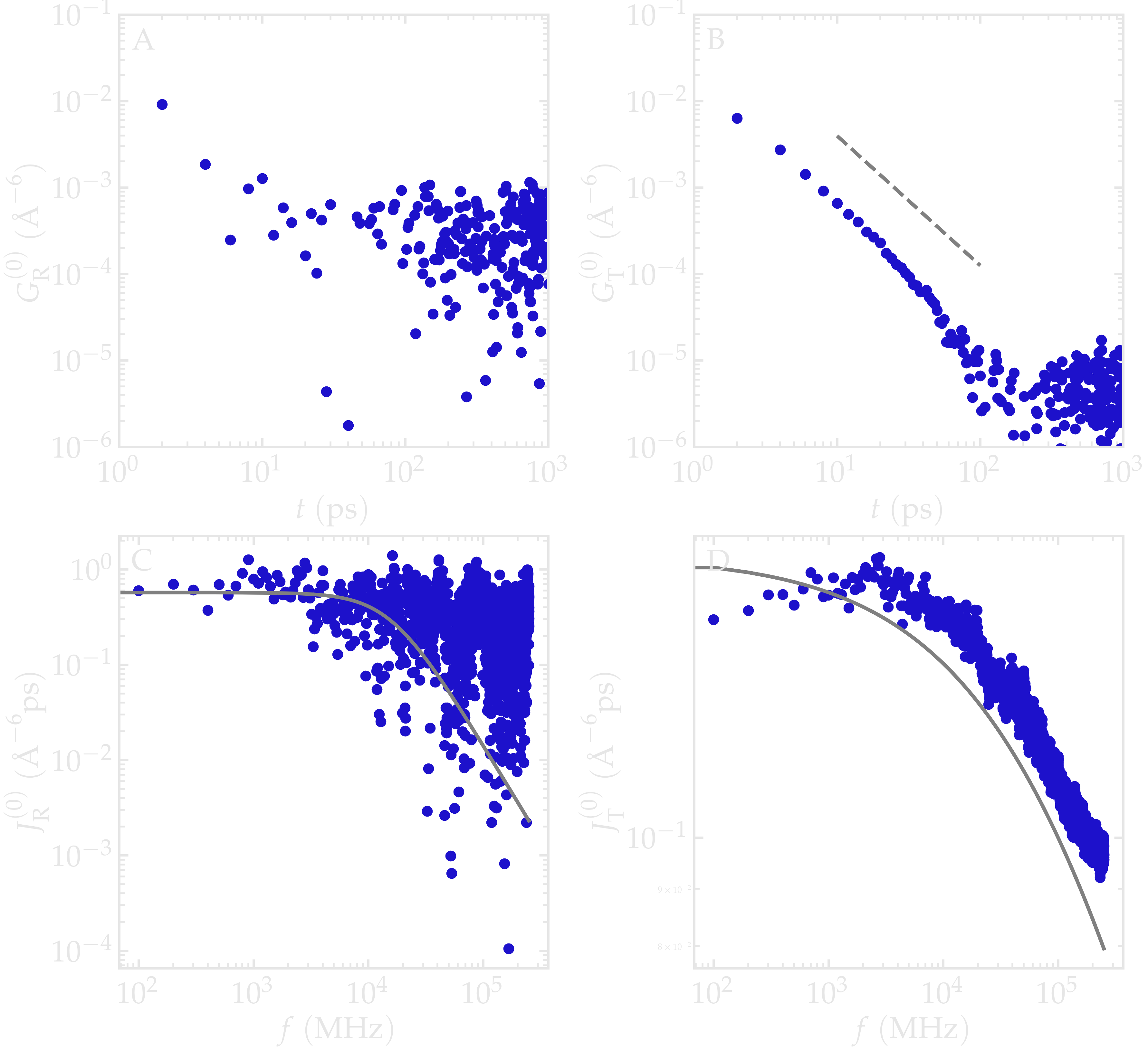
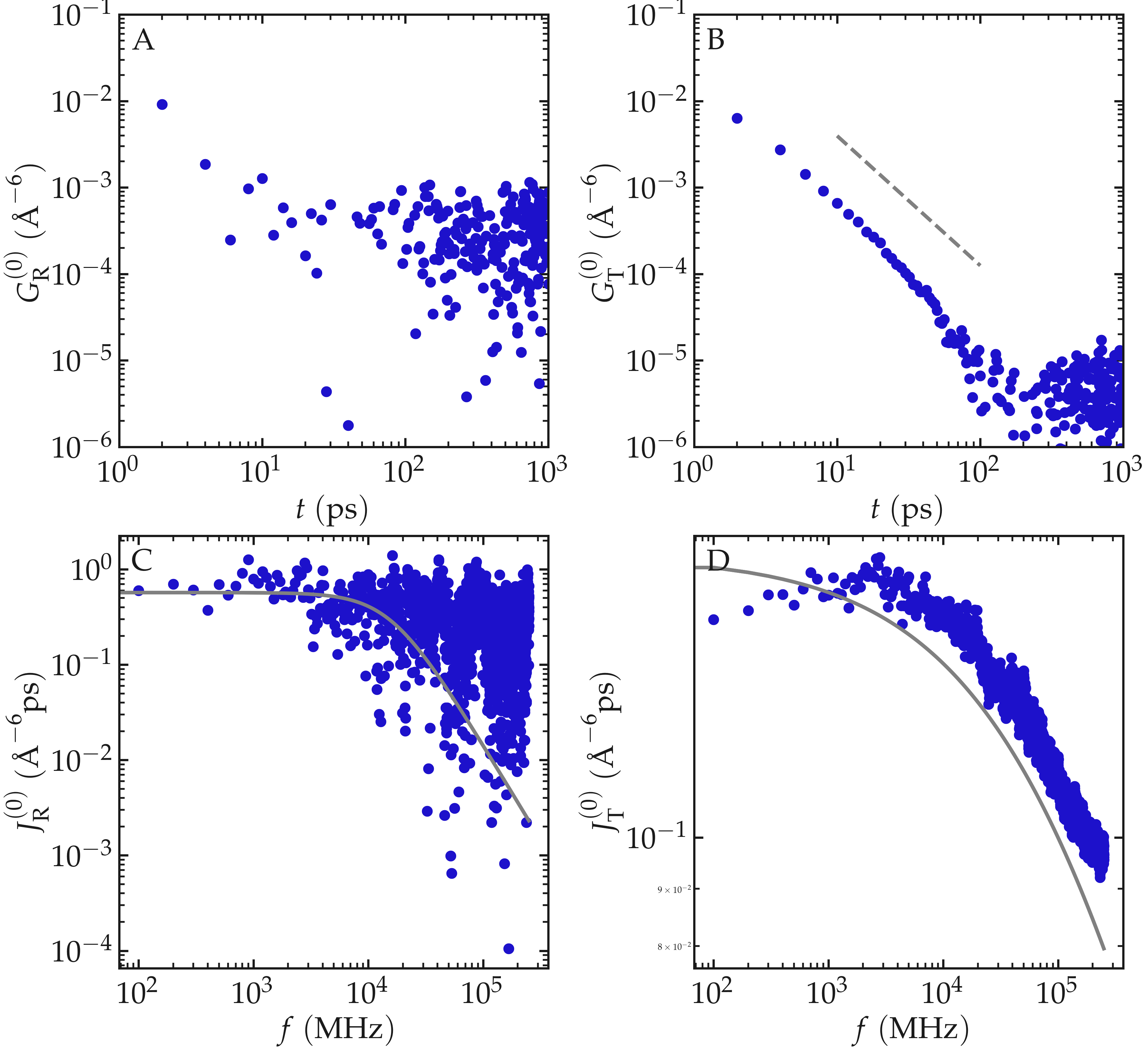
Figure: (A) Intramolecular dipolar correlation function \(G^{(0)}_\mathrm{intra}(t)\). (B) Intermolecular dipolar correlation function \(G^{(0)}_\mathrm{inter}(t)\), shown on a log-log scale. The dashed line indicates the long-time scaling \(G(t) \propto t^{-3/2}\), characteristic of translational diffusion. (C) Intramolecular spectral density \(J^{(0)}_\mathrm{intra}(f)\). The solid line corresponds to a Lorentzian fit based on a single correlation time approximation. (D) Intermolecular spectral density \(J^{(0)}_\mathrm{inter}(f)\). The solid line shows the analytical prediction based on adsorption-diffusion.
The different physical origins of intra- and intermolecular relaxation are reflected in their spectral densities. Intramolecular relaxation is dominated by molecular rotation and can therefore be described by a single correlation time approximation. In contrast, intermolecular relaxation is affected by translational diffusion and requires a different description.
The intramolecular spectrum \(J_\textrm{intra}^{(0)}\) can be reasonably well described by a Lorentzian:
using \(\tau_\text{c} = 6.3\) ps and \(G(0) = 56300~\mathrm{Å}^{-6}\,\mathrm{ps}^{-2}\) for \(T = 300\) K, and \(\tau_\text{c} = 3.2\) ps and \(G(0) = 59500~\mathrm{Å}^{-6}\,\mathrm{ps}^{-2}\) for \(T = 275\) K.
The intermolecular spectral density \(J_\mathrm{inter}^{(0)}\), however, does not exhibit a Lorentzian plateau at low frequencies. This deviation is directly related to the long-time power-law decay observed in the corresponding correlation function \(G_\mathrm{inter}^{(0)}(t)\).
In particular, the algebraic decay \(G(t) \sim t^{-3/2}\) is characteristic of translational diffusion and indicates that the relaxation dynamics is not governed by a single characteristic correlation time.
In this regime, and following closely Ref. [57], the spectral density can be described by adsorption-diffusion, which yields an analytical expression based on first-passage statistics in a diffusive reservoir:
Within this framework, the parameters have a direct physical interpretation: \(A = k r / D\) and \(B = r / \sqrt{D}\), where \(r\) is the molecular radius, \(D\) the self-diffusion coefficient, and \(k\) a phenomenological exchange rate (with units of m/s) describing effective adsorption-desorption kinetics.
The resulting frequency dependence captures the crossover from a quasi-plateau at low frequency to a diffusion-dominated decay at higher frequencies.
As shown in panel (D), the ADHF model provides a good description of the molecular dynamics results up to approximately \(10^4\,\mathrm{MHz}\).