Lysozyme in water
The system consists of a lysozyme (HEWL) and 594 water molecules. The temperature is \(T = 300~\mathrm{K}\), and the water model is \(\text{TIP4P}-\epsilon\). Simulation details are provided in Simulation methods.
The total NMR relaxation rate \(R_1\) exhibits a strong frequency dependence across the entire accessible frequency range, in contrast to simple bulk liquids, where \(R_1\) reaches a low-frequency plateau. Decomposing the signal into water and lysozyme contributions reveals that the low-frequency dispersion is dominated by the protein (Figure 1). This reflects the slow rotational tumbling of the lysozyme molecule, which has a much longer correlation time than the small solvent molecules.
The water contribution alone also shows a residual frequency dependence at low frequencies, which is absent in bulk water. In bulk water, \(R_1\) reaches a plateau below approximately \(2 \cdot 10^3\,\text{MHz}\), indicating that molecular motion is fast relative to the NMR timescale. In contrast, water molecules in contact with the lysozyme surface show dispersion extending down to approximately \(10\,\text{MHz}\). This is consistent with the expected slowdown of the translational and rotational dynamics of adsorbed water molecules, whose motion is partially constrained by interactions with the protein surface.
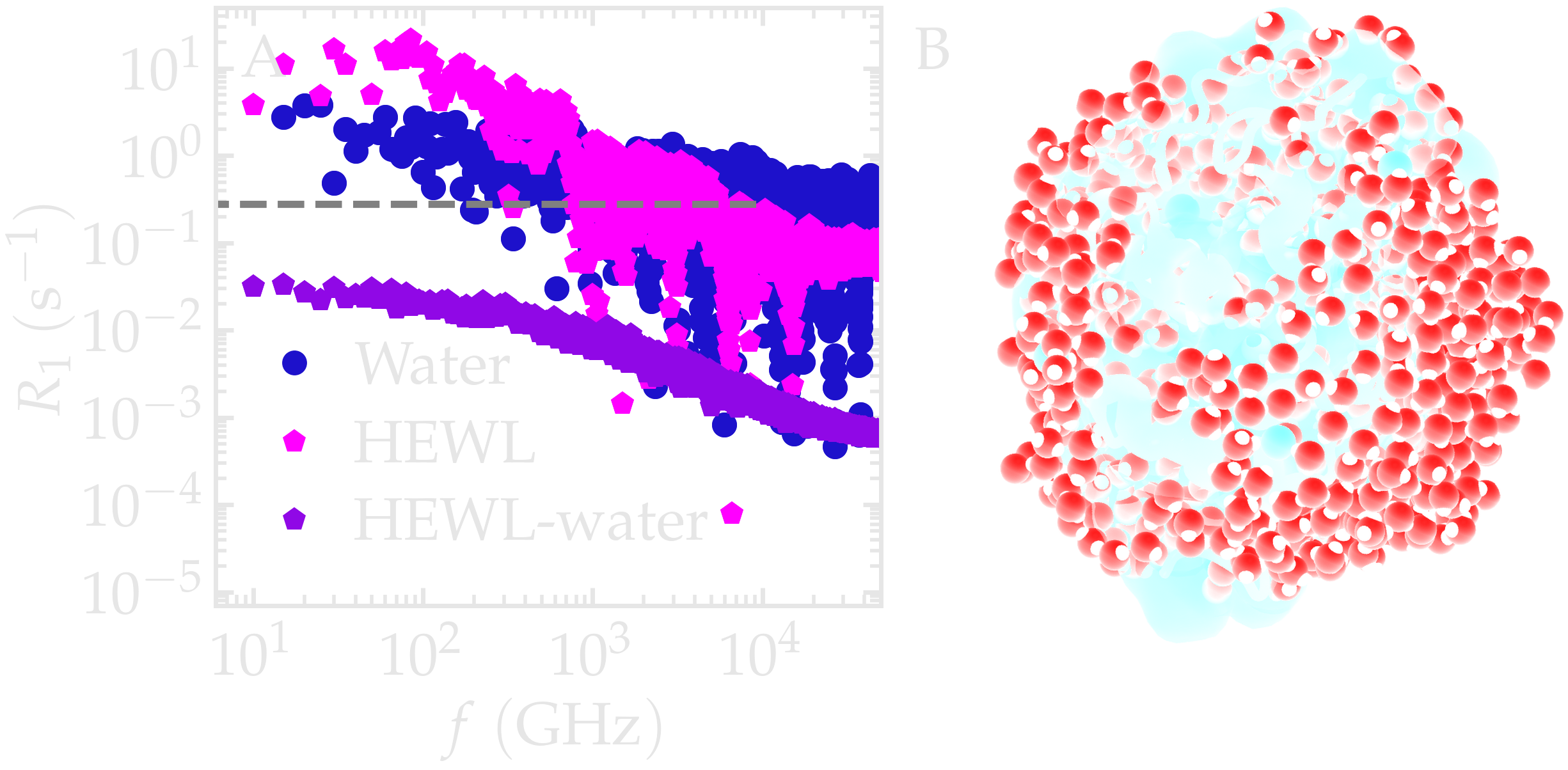
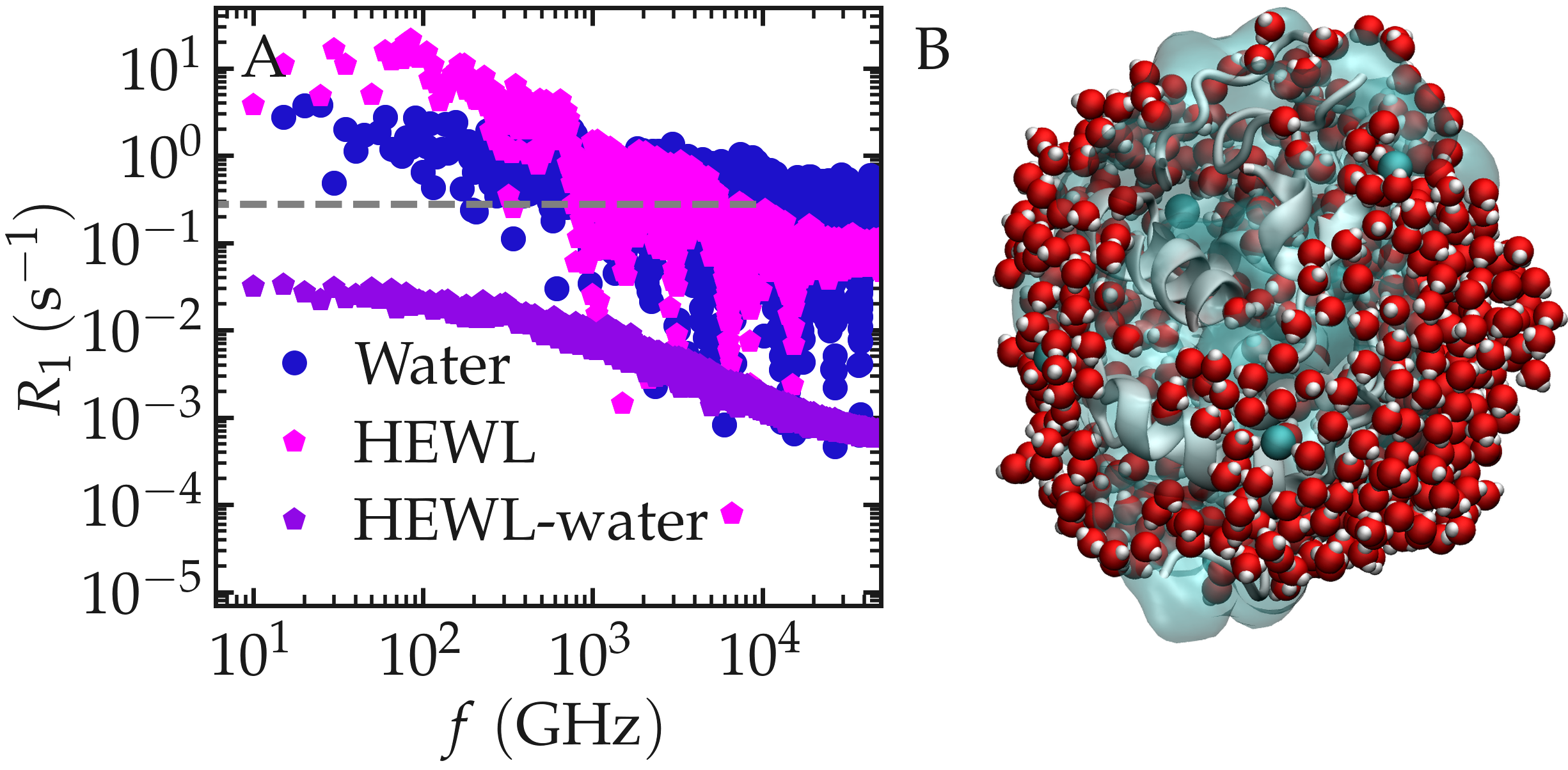
Figure 1. (A) NMR relaxation rate \(R_1\) for the lysozyme–water system. The spectra for water alone and lysozyme alone are shown, alongside the contribution for the water-lysozyme interaction. (B) Snapshot of the molecular dynamics simulation.